Mission & History
Chair
- Kate Lyons (katelyons@unl.edu)
Members
|
|
|
History and Mission
In 2002, the American Society of Mammalogists established 2 new conservation awards to recognize outstanding contributions to the conservation of mammals and their habitats.
Aldo Leopold Award
The first award, the Aldo Leopold Award, is awarded to a well-established individual who has made a lasting contribution to the conservation of mammals and their habitats. In 2003, the inaugural Aldo Leopold Award recipient was E. O. Wilson of Harvard University for his valuable contributions to mammalian conservation through his development and promotion of the concepts of biodiversity.
Murie Family Conservation Award
The second award, the Murie Family Conservation Award, is awarded to a current undergraduate or graduate student, post-doctoral fellow, or early career researcher (within 5 years of their terminal degree) who has made a significant contribution to the conservation of mammals and their habitats. Originally called the William T. Hornaday Award, nominations were first taken in 2004.
2023 Aldo Leopold Award Recipient
The recipient of the 2023 Aldo Leopold award is Vernon Bleich. Vern Bleich received BS (1970) and MA (1973) degrees from California State University Long Beach and earned a Ph.D. from the University of Alaska Fairbanks in 1993. Now retired, he was an employee of the California Department of Fish and Game (CDFG) for 34 years where he acquired vast knowledge and expertise regarding the behavior, distribution, ecology, life histories, and habitat requirements of bighorn sheep, mule deer, mountain lions among other species occupying arid and montane ecosystems. He also holds or held affiliated appointments at the University of Nevada Reno, Idaho State University and the University of Alaska Fairbanks. During his career with CDFG he was responsible for the restoration of numerous populations of bighorn sheep to then vacant mountain ranges, was a member of the Peninsular Bighorn Sheep Recovery Team, and served as Project Leader of the Sierra Nevada Bighorn Sheep Recovery Program from 2001 to 2008, during which he oversaw preparation of the Sierra Nevada Bighorn Sheep Recovery Plan. Vern and his co-authors were among the first to apply the concept of metapopulation dynamics to the management and conservation of large mammals and integrated behavioral ecology theory into studies on sexual segregation and mating systems. He has published widely in the professional literature with over 200 publications. He is the recipient of numerous awards from academia, conservation organizations, and professional societies. In 1999, Vern was nominated and elected as a Professional Member of the Boone and Crockett Club, and he is a Life Member of the Society for the Conservation of Bighorn Sheep, Wild Sheep Foundation, and California Wild Sheep Foundation and the American Society of Mammalogists. Vern and his family now reside in Bismarck, North Dakota, where he remains active in the conservation of bighorn sheep and other large mammals occupying the arid environments and northern plains of western North America, enjoys the outdoors and spending time with his grandchildren.
2023 Murie Family Conservation Award
|
Image
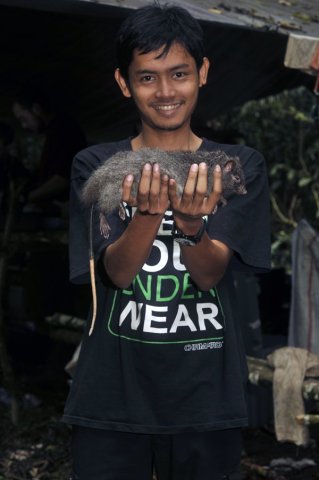 |
The 2023 recipient of the Murie Family Conservation Award is Heru Handika. Mr. Handika received his B.S. from Andalas University, where he is a permanent member of a mountaineering and conservation club, KCA-LH Rafflesia FMIPA Andalas. In 2017, he graduated with an M.S. from the University of Melbourne, and he is now a Ph.D. candidate at Louisiana State University. Mr. Handika was born and raised in Padang, West Sumatra, Indonesia. During his youth, he developed seemingly independent interests in mountains, computers, and mammals. These interests would eventually collide to form the basis of his current research and conservation efforts. Mr. Handika’s research centers on the diversity and evolutionary history of small mammals in the islands of Southeast Asia. To improve the accessibility of this type of research, he develops software that enables data acquisition and analysis on inexpensive computers and mobile devices. Mr. Handika has also devoted significant time to conducting basic mammalian inventories, including over 30 expeditions in Indonesia, Malaysia, and the Philippines, where he frequently trains local students. These field inventories represent a major contribution to our understanding of mammalian diversity and endemism in Southeast Asia. |
Streaming Presentations
ASM Members can log into the Business Office site and stream presentations from past winners!
Namesakes
Aldo Leopold Award
We are proud to honor the memory of former ASM member Aldo Leopold with the senior award. Not only did Aldo Leopold have a significant and lasting influence in wildlife conservation and management, but he also had a great interest in mammals. He was an active member of ASM and a member of the Conservation of Land Mammals Committee (4 years) in the 1930s and during this time worked to defend wolves in Wisconsin and the Great Lakes states and grizzly bears in New Mexico. Leopold is well known for his famous land ethic philosophy, and is considered to be the “father” of wildlife ecology and management. His son, A. Starker Leopold, served as Chair of the Conservation of Land Mammals Committee in the 1950s. Students of both generations of Leopolds have had a profound impact on the field of mammalogy.
The Murie Family Conservation Award (2020+)
Among the founding figures in wildlife management and conservation biology are the half-brothers Olaus and Adolph Murie and their wives (also half-sisters!) Margaret (Mardy) and Louise. Olaus Murie conducted and published groundbreaking research on a variety of large mammals, much of it focused on Alaska, Wyoming, and Canada. He was an early biologist for the US Bureau of Biological Survey and served as president of both The Wilderness Society and Wildlife Society (1944–45). Margaret Murie was a naturalist and a conservationist, received the Presidential Medal of Freedom in 1998, and was called the “Grandmother of the Conservation Movement” by both the Sierra Club and the Wilderness Society. Olaus and Mardy secured passage of the Alaska National Interest Lands Conservation Act, expansion of Olympic National Park, and creation of the Jackson Hole National Monument, among many other achievements. Adolph Murie was an ecologist and a strong proponent of science-based and ecologically informed wildlife management. He worked for the Wildlife Division of the National Park Service, conducting now-classic studies on a number of predator and prey species. The first scientist to study wolves in their natural habitat, his book The Wolves of Mt. McKinley is widely considered a classic. Louise Murie was a botanist, made 25 expeditions to Mt. McKinley (now Denali) National Park, and served on the board of directors for the Jackson Hole Conservation Alliance. She made extensive collections of plants from Denali and other places. Settling in Jackson Hole in 1945, Louise continued with work in conservation and community service, including work with the Teton Science Schools, the Jackson Hole Conservation Alliance, and The Murie Center. The legacy of the Murie Family continues through their children, the many students and colleagues who have followed in their path, and the wonderful wilderness areas that are now protected because of their efforts.
William T. Hornaday Award (2003-2019)
William T. Hornaday was a pioneer in wildlife conservation and the “architect” of two of the most renowned zoological parks in the United States, the National Zoo in Washington, D.C. and the New York Zoological Park in Bronx, New York. Hornaday was responsible for a number of early wildlife protection laws in the US, was instrumental in saving the northern fur seal from extinction, and authored 15 books and numerous articles about wildlife and the need for conservation. The fate of the American bison seemed to stir Hornaday most deeply, perhaps because he had himself witnessed the systematic slaughter of this species in the west. His 1889 book entitled “The extermination of the American bison” established him as a prominent defender of these animals. In the early 1900s, he founded the National Bison Society and promoted the establishment of the herds at Wichita Mountains in Oklahoma and the National Bison Range in Montana. However, review of Hornaday’s writings and political assertions reveals that they are in conflict with the ASM’s committment to promoting diversity, embracing inclusivity, and actively engaging with anyone with an interest in mammals. Thus, in July 2020 the ASM Board of Directors voted to rename this award as the Murie Family Conservation Award, thereby recognizing one of the founding families in wildlife and wilderness conservation.
To Nominate
The Aldo Leopold Award is awarded to a well-established individual who has made a lasting contribution to the conservation of mammals and their habitats.
The Murie Family Conservation Award is awarded to a current undergraduate or graduate student who has made a significant contribution as a student to the conservation of mammals and their habitats.
The recipient of each award will have contributed substantially to (1) the conservation of 1 or more mammalian species, subspecies, or populations, (2) the conservation of mammalian assemblages and communities, and/or (3) advancing the field of conservation biology through focal research on mammals. We interpret “contribution” broadly to include (1) scientific research or political activism that has resulted in the preservation of an imperiled species; (2) development of protective management recommendations; (3) acquisition of new knowledge regarding the conservation status or causes for decline of mammalian species or populations; (4) the protection of significant mammalian habitat; or (5) promotion of the conservation of mammals through public education.
- A brief (2 pages maximum) narrative that introduces and describes the conservation activities of the nominee;
- A list of relevant journal articles, government and NGO reports, newspaper clippings, and other materials that chronicle and corroborate the conservation-related activities of the nominee;
- Contact information for the nominator and nominee;
- Inclusion of the statement...
As a part of preparing this nomination, I have read and understood the American Society of Mammalogists' Code of Professional Conduct (here). To the best of my knowledge, the individual I am nominating exemplifies the high caliber of professional conduct that the ASM expects and promotes as required to be eligible for this award, as well as to retain this recognition should they be the award recipient. - Supporting material as follows:
Aldo Leopold Award -- A complete nomination packet (nominating letter, curriculum vita, 3 pieces of corroborative literature that most succinctly and directly describe the nominee’s contributions to mammalian conservation, and up to 4 additional letters of support) should be submitted (as a single PDF file) to Kate Lyons (katelyons@unl.edu) by 1 March. Nominations will be retained for two years.
Murie Family Conservation Award -- Letters of recommendation from 2 individuals familiar with the nominee’s conservation activities. One of these letters must be from the student’s research advisor that confirms the nominee’s status as a student or early career researcher with 5 years of receiving their terminal degree. Completed nomination packets (as a single PDF file) should be sent to Kate Lyons (katelyons@unl.edu). Deadline for submission of completed nominations is 1 March. The recipient will be announced at the annual meeting of the Society. Nominations are not retained from previous years. Please send any questions about the award or the nomination to Kate Lyons (katelyons@unl.edu).
Annual Reports
Recipients
ALDO LEOPOLD CONSERVATION AWARD
for outstanding contributions to the conservation of mammals and mammalian biodiversity
- 2003—Edward O. Wilson, Harvard University, Cambridge, MA
- 2004—Russell A. Mittermeier, Conservation International, Washington, DC
- 2005—George B. Schaller, Wildlife Conservation Society, Bronx, NY
- 2007—Rodrigo A. Medellín, Instituto de Ecología, UNAM, Ciudad de México, México
- 2008—Virgilio G. Roig, Jardín Zoológico de Mendoza, Mendoza, Argentina
- 2009—Helene Marsh, James Cook University, Townsville, Queensland, Australia
- 2010—Herbert Prins, Chair of Resource Ecology, Wageningen University, The Netherlands
- 2011—Rubén Bárquez, Consejo Nacional de Investigaciones Científicas y Técnicas (CONICET of Argentina), Buenos Aires, Argentina
- 2012—Dean Biggins, US Geological Service, Fort Collins, CO
- 2013—Joel Berger, University of Montana, Missoula, MT
- 2014—Lawrence R. Heaney, Field Museum of Natural History, Chicago, IL
- 2015—Andrew T. Smith, Arizona State University, Tempe, AZ
- 2016—Marco Festa-Bianchet, Université de Sherbrooke, Québec, Canada
- 2017—Gerardo Ceballos, Instituto de Ecología, UNAM, Ciudad de México, México
- 2018—Steve Goodman, Field Museum of Natural History, Chicago, IL
- 2019—Bernal Rodríguez-Herrera, Universidad de Costa Rica, San José, Costa Rica
- 2020—Gladys Kalema-Zikusoka, Conservation Through Public Health
- 2021—Thomas E. Lachler Jr., Texas A&M
- 2023—Vernon Bleich, California Department of Fish and Game
- 2024—Matthew Kauffman, USGS and University of Wyoming
- 2025—Bill McShea, Smithsonian Conservation Biology Institute
- 2026—José González-Maya, Universidad Autónoma Metropolitana
MURIE FAMILY CONSERVATION AWARD
presented to a student/young professional who has made a significant contribution as a student to the conservation of mammals and their habitats.
- 2020—Jennifer A. Guyton, Princeton University
- 2022—Monica Engel, Memorial University, Canada
- 2023—Heru Handika, Louisiana State University
- 2024—Saeideh Esmaeili, Colorado State University
- 2025—Michael Peers, Memorial University of Newfoundland
- 2026—April Martinig, Université de Sherbrooke
WILLIAM T. HORNADAY CONSERVATION AWARD (2004-2019)
presented to a student/young professional who has made a significant contribution as a student to the conservation of mammals and their habitats.
- 2004—Brent Sewall, University of California, Davis, CA
- 2005—Isabel Beasley, James Cook University, Queensland, Australia
- 2008—Angelia S. M. Vanderlaan, Oceanography Department, Dalhousie University, Halifax, Nova Scotia, Canada
- 2009—Gerrit Jan Schipper III, Ph.D. Student, Director of IUCN-SSC/CI-CABS Global Mammal Assessment, Arlington, VA; University of Idaho/CATIE, Moscow, ID
- 2011—Enzo Aliaga-Rosel University of Hawai`i at Manoa, Manoa, HI
- 2013—Abdullahi Hussein Ali Ph.D. student, University of Wyoming, Laramie, WY
- 2014—Erin Baerwald Ph.D. student, University of Calgary, Calgary, Alberta
- 2015—José F. González-Maya Ph.D. student, Instituto de Ecología, UNAM, Ciudad de México, México
- 2016—Héctor Ramirez-Chaves Ph.D. student, University of Queensland, Australia
- 2017—Roberto Salom-Pérez Ph.D. student, University of Idaho & Centro Agronómico Tropical de Investigación y Enseñanza (CATIE), Costa Rica
- 2018—Kristoffer Everatt Ph.D. student, Nelson Mandela University in Port Elizabeth South Africa
- 2019—Clayton Lamb Ph.D. student, University of Alberta, Edmonton, Alberta